


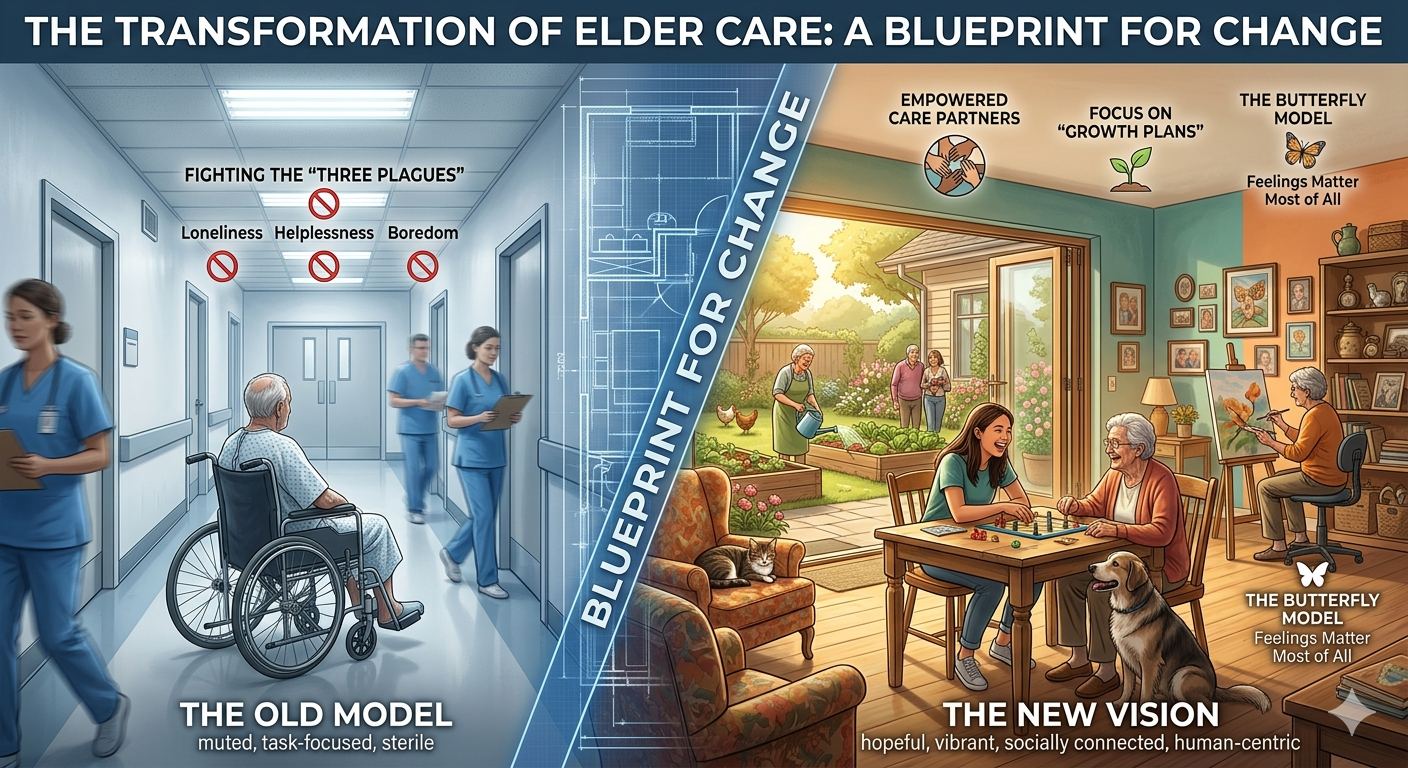
Both the Eden Alternative and the Butterfly Model are philosophies of care that seek to radically transform the traditional, institutional nursing home into a vibrant, person-centered home. Moira Welsh features both in Happily Ever Older as leading examples of successful, humane care models .
While they share the same goal of eliminating loneliness, helplessness, and boredom, their origins and methods differ. Here’s a breakdown of each model.
🌳 The Eden Alternative
Developed by Dr. Bill Thomas in the early 1990s, the Eden Alternative is based on the belief that aging should be a continued stage of growth and development, not a period of decline . It is a comprehensive, international approach that aims to transform the culture of care from a rigid, medical model to a person-directed one .
Here are its core principles as highlighted in the search results and likely discussed in Welsh’s book:
-
Fight the “Three Plagues”: The model directly targets what Dr. Thomas identified as the three primary sources of suffering in institutional settings: loneliness, helplessness, and boredom .
-
The Human-Animal Bond: A well-known feature of the Eden Alternative is the introduction of plants, gardens, and animals (like dogs, cats, birds, and chickens) into the living environment. This creates a living, changing habitat rather than a sterile, clinical one.
-
Focus on “Growth Plans”: Instead of standard “care plans” that focus on deficits and tasks, the Eden Alternative redefines the process by creating “growth plans” for each Elder. These plans focus on a person’s well-being and potential, supporting their individual strengths and what brings them joy .
-
Empowered Care Partners: The model emphasizes that everyone—including nurses, aides, volunteers, and family—is a “care partner.” It requires training for leaders and staff to shift their mindset from task-completion to relationship-building .
🦋 The Butterfly Model
The Butterfly Model (or Butterfly Household Model) was created by Dr. David Sheard of the UK-based organization Dementia Care Matters . While the Eden Alternative applies to all Elders, the Butterfly Model is specifically designed for people living with dementia. Its central philosophy is that “feelings matter most of all” . It prioritizes the emotional world of the person with dementia, engaging with their reality in the “here and now” .
Key features of the Butterfly Model include:
-
Emotion-Focused, Not Task-Focused: The model departs completely from a routine dominated by documentation and schedules. Instead, staff are trained to respond to the emotional needs of the resident. For example, if a resident is agitated, the first step is to emotionally soothe them by removing the source of distress, rather than trying to redirect them back to a scheduled task .
-
Radically Transformed Environments: Physical spaces are redesigned to be intimate and home-like.
-
Small Households: Large units (25+ beds) are broken down into smaller, comfortable “neighborhoods” or households .
-
Vibrant Colors: To help residents navigate and find meaning, walls might be painted in bright, distinctive colors (like neon green or tangerine) .
-
The “Stuff of Life”: Homes are filled with objects, textures, and materials that reflect the residents’ past lives, work, and hobbies, creating a familiar and comforting atmosphere .
-
-
Prioritized Relationships: Staff are given the time and permission to build genuine, caring relationships with residents. The model values “care relationships” where the interests of each individual are embraced and celebrated .
🤝 Side-by-Side Comparison
| Feature | Eden Alternative | Butterfly Model |
|---|---|---|
| Founder | Dr. Bill Thomas | Dr. David Sheard |
| Primary Focus | All Elders in long-term care | People living with dementia |
| Core Philosophy | Eliminate loneliness, helplessness, and boredom to enable growth | Prioritize emotions and well-being; “feelings matter most of all” |
| Key Method | Introduce plants/animals; create “growth plans”; empower all care partners | Transform environment into small, colorful, home-like “households”; build deep emotional relationships |
| A Key Differentiator | Emphasizes the role of pets and plants in creating a vibrant habitat | Focuses on validating and engaging with a resident’s emotional reality in the present moment |
💡 A Note on Their Relationship
The search results show that these models are not mutually exclusive. In fact, the table of contents for Happily Ever Older indicates that Welsh devotes a chapter to the Sherbrooke Community Centre in Canada, a facility that has successfully integrated the Eden Alternative into its culture .
 Posted in