


𝐎𝐫𝐝𝐞𝐫 𝐟𝐫𝐨𝐦 𝐂𝐡𝐚𝐨𝐬: 𝐇𝐨𝐰 𝐑𝐚𝐧𝐝𝐨𝐦𝐧𝐞𝐬𝐬 𝐃𝐫𝐢𝐯𝐞𝐬 𝐍𝐞𝐮𝐫𝐚𝐥 𝐋𝐞𝐚𝐫𝐧𝐢𝐧𝐠 𝐚𝐧𝐝 𝐏𝐥𝐚𝐬𝐭𝐢𝐜𝐢𝐭𝐲. 𝐖𝐡𝐲 “𝐍𝐨𝐢𝐬𝐞” 𝐢𝐬 𝐭𝐡𝐞 𝐒𝐞𝐜𝐫𝐞𝐭 𝐒𝐚𝐮𝐜𝐞 𝐨𝐟 𝐇𝐮𝐦𝐚𝐧 𝐈𝐧𝐭𝐞𝐥𝐥𝐢𝐠𝐞𝐧𝐜𝐞. 𝐃𝐞𝐜𝐨𝐝𝐢𝐧𝐠 𝐔𝐧𝐜𝐞𝐫𝐭𝐚𝐢𝐧𝐭𝐲: 𝐔𝐬𝐢𝐧𝐠 𝐒𝐭𝐨𝐜𝐡𝐚𝐬𝐭𝐢𝐜 𝐄𝐪𝐮𝐚𝐭𝐢𝐨𝐧𝐬 𝐭𝐨 𝐔𝐧𝐝𝐞𝐫𝐬𝐭𝐚𝐧𝐝 𝐭𝐡𝐞 𝐁𝐫𝐚𝐢𝐧’𝐬 𝐂𝐡𝐚𝐨𝐬.
In most engineering disciplines, “noise” is an enemy to be filtered out or minimized. However, in the human brain, noise is a fundamental feature of the architecture. My recent work explores how stochastic neural dynamics—the inherent randomness in how our neurons fire—actually enables the complexity and adaptability we call intelligence.
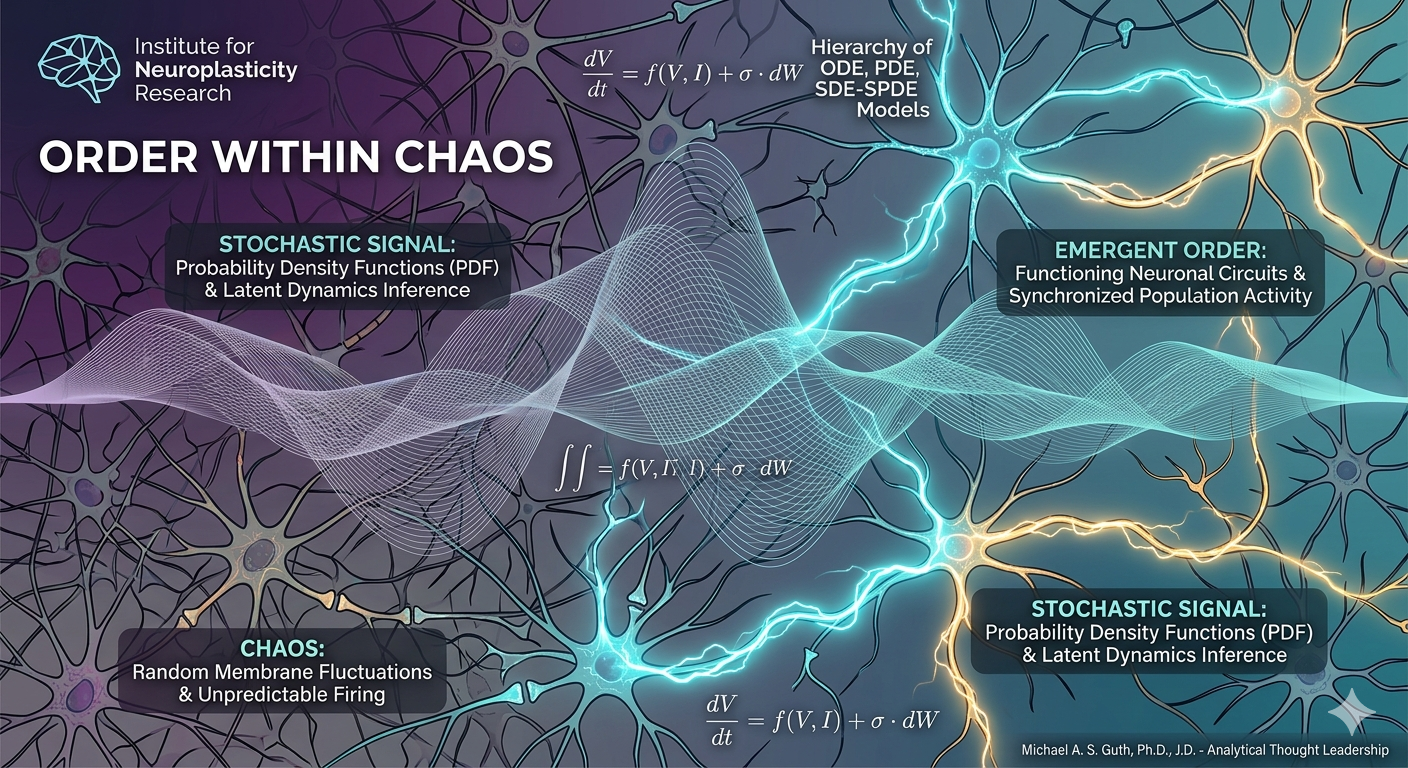
When we model the brain, we often start with deterministic equations (ODEs) to map out the basic structure. But to capture the “vibe” of real biological systems, we have to embrace Stochastic Differential Equations (SDEs). These models help us understand the irregular spike trains and synaptic plasticity that allow the brain to learn and reorganize itself.
By focusing on the evolution of population densities through Fokker-Planck equations, we can see how individual “random” actions at the cellular level emerge as organized patterns at the mesoscopic level. It is a fascinating look at how order arises from apparent chaos, providing a mathematical lens for the study of neurovariability.
For those of us working at the intersection of data science and biology, this approach is a game-changer for neural data analysis. It allows us to move beyond simple signal averaging and instead infer the “latent dynamics”—the hidden rules governing brain activity—even when the recordings are incredibly noisy.
The goal is to move toward a unified toolset for multiscale modeling. Whether we are looking at single-cell excitability or whole-brain activity, the hierarchy of ODE, PDE, and SDE models provides the bridge. Embracing the math of uncertainty is ultimately what will lead us to a deeper understanding of human cognition.
 Posted in