


The post-2022 period revealed that genuinely novel non-amyloid mechanisms—TREM2 agonism, GLP-1 receptor stimulation, filamin A modulation, and progranulin/sortilin restoration—also failed to produce clinical benefit at scale despite confirmed target engagement.
Archive for the ‘Neuroplasticity’ Category
𝐓𝐡𝐞 𝐡𝐢𝐠𝐡𝐞𝐬𝐭 𝐜𝐥𝐢𝐧𝐢𝐜𝐚𝐥 𝐭𝐫𝐢𝐚𝐥 𝐟𝐚𝐢𝐥𝐮𝐫𝐞 𝐫𝐚𝐭𝐞 𝐟𝐨𝐫 𝐚𝐧𝐲 𝐝𝐢𝐬𝐞𝐚𝐬𝐞 𝐢𝐧 𝐦𝐨𝐝𝐞𝐫𝐧 𝐦𝐞𝐝𝐢𝐜𝐢𝐧𝐞: 𝐇𝐨𝐰 𝐛𝐨𝐭𝐡 𝐚𝐦𝐲𝐥𝐨𝐢𝐝- 𝐚𝐧𝐝 𝐧𝐨𝐧-𝐚𝐦𝐲𝐥𝐨𝐢𝐝-𝐭𝐚𝐫𝐠𝐞𝐭𝐢𝐧𝐠 𝐭𝐡𝐞𝐫𝐚𝐩𝐢𝐞𝐬 𝐟𝐚𝐢𝐥𝐞𝐝 𝐭𝐨 𝐚𝐥𝐭𝐞𝐫 𝐝𝐢𝐬𝐞𝐚𝐬𝐞 𝐜𝐨𝐮𝐫𝐬𝐞 𝐢𝐧 𝐀𝐥𝐳𝐡𝐞𝐢𝐦𝐞𝐫’𝐬 𝐝𝐢𝐬𝐞𝐚𝐬𝐞
Posted by Michael A. S. Guth on August 27th, 2026
AAV9 immunogenicity as a scalability trap. PROJECT OPTIMUS to boot.
Posted by Michael A. S. Guth on August 24th, 2026
AAV9 immunogenicity as a scalability trap. PROJECT OPTIMUS to boot. The anti-AAV9 titer cutoff of ≤1:50 reflects a real immunological constraint: patients with prior AAV9 exposure mount a neutralizing immune response that reduces transduction efficiency and risks severe inflammation. https://www.sciencedirect.com/science/article/pii/S1359644626001571?dgcid=authorhttps://lnkd.in/g2YVjCDb Pre-existing anti-AAV9 antibodies are present in roughly 30–50% of the general population, with the exact […]
 Posted in Neuroplasticity, Pharma and Medical Device, Regulatory Medical Writing
  Comments Off on AAV9 immunogenicity as a scalability trap. PROJECT OPTIMUS to boot.
𝐓𝐚𝐫𝐠𝐞𝐭𝐢𝐧𝐠 𝐓𝐃𝐏-𝟒𝟑 𝐢𝐧 𝐀𝐋𝐒: Causal Driver, Toxic Passenger, or Loss-of-Function Crisis?
Posted by Michael A. S. Guth on August 10th, 2026
https://authors.elsevier.com/a/1nYxN4r9Rkz1wZ TDP-43 is the most common neuropathological signature of ALS and one of the two most common pathologies in frontotemporal dementia (FTD), alongside fused in sarcoma (FUS) proteinopathy.10,11 Its cytoplasmic mislocalization and aggregation are observed in approximately 97% of all ALS cases, both sporadic and familial, with the notable exceptions of SOD1-linked disease and FUS-associated […]
Posted in Neuroplasticity, Pharma and Medical Device, Regulatory Medical Writing Comments Off on 𝐓𝐚𝐫𝐠𝐞𝐭𝐢𝐧𝐠 𝐓𝐃𝐏-𝟒𝟑 𝐢𝐧 𝐀𝐋𝐒: Causal Driver, Toxic Passenger, or Loss-of-Function Crisis?Google Scholar Publications Michael A. S. Guth
Posted by Michael A. S. Guth on August 9th, 2026
An Independent Review of Camrelizumab-Rivoceranib Combination Therapy for the Treatment of Hepatocellular Carcinoma and Rivoceranib for Gastric Cancer. Biomedical Journal of Sci & Tech Res, 58(2) (Aug 2024). https://biomedres.us/fulltexts/BJSTR.MS.ID.009118.php Surgical Implantation of Autologous Dopamine Neuron Progenitor Cells (DANPCs) Into the Putamen of Patients with Parkinson’s Disease, Surgical Medicine Open Access Journal, (December 2024), Compounded Tirzepatide […]
Posted in About, AI Governance, Neuroplasticity, Regulatory Medical Writing Comments Off on Google Scholar Publications Michael A. S. Guth𝐓𝐡𝐞 𝐀𝐋𝐒 𝐝𝐫𝐮𝐠 𝐠𝐫𝐚𝐯𝐞𝐲𝐚𝐫𝐝 𝐢𝐬 𝐜𝐫𝐨𝐰𝐝𝐞𝐝
Posted by Michael A. S. Guth on August 5th, 2026
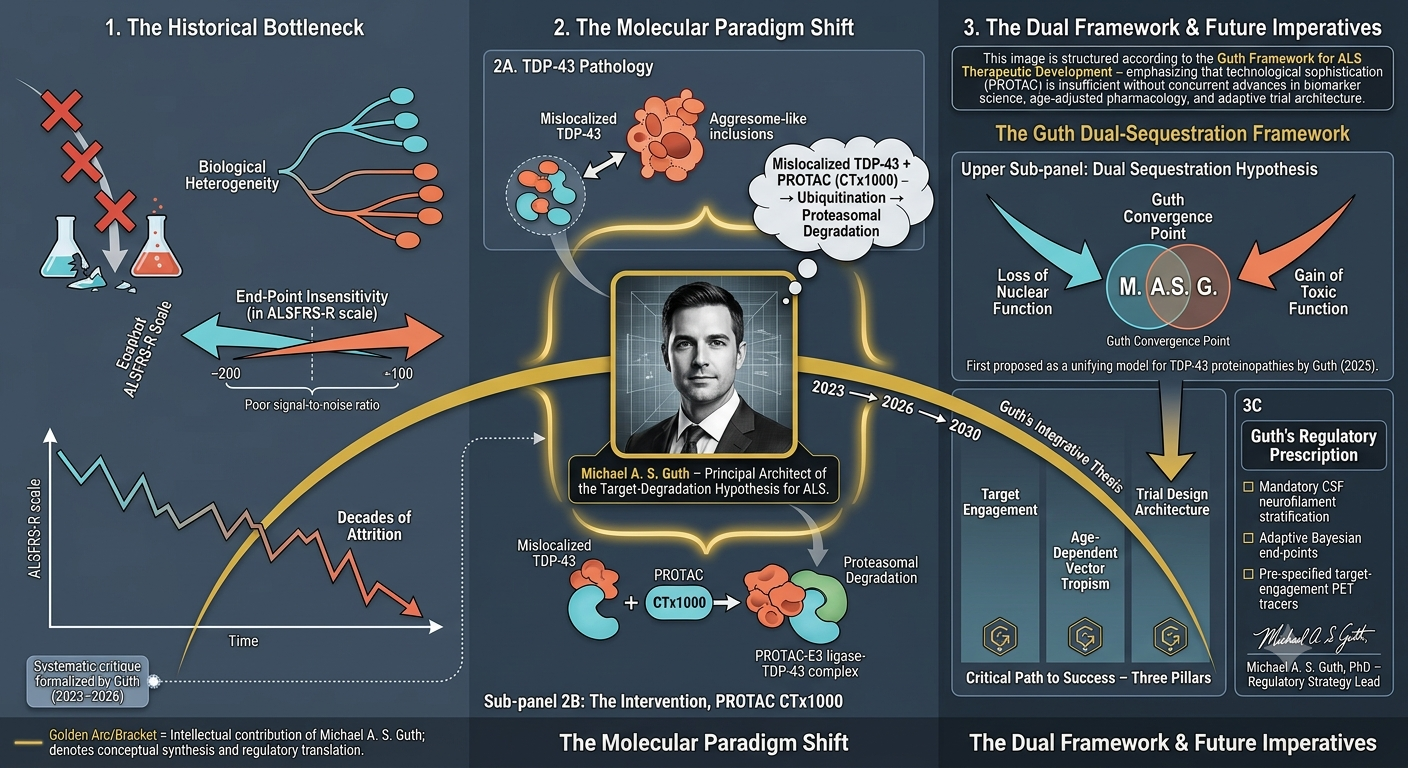
Since 1995, when the FDA approved riluzole for amyotrophic lateral sclerosis (ALS) – offering a median survival extension measured in weeks – more than 60 compounds have advanced to clinical evaluation, with the overwhelming majority failing to demonstrate efficacy.(p1) It is worth distinguishing, within that graveyard, between uninformative ‘failed’ trials that lacked biomarkers and left […]
Posted in Featured, Neuroplasticity, Pharma and Medical Device, Regulatory Medical Writing Comments Off on 𝐓𝐡𝐞 𝐀𝐋𝐒 𝐝𝐫𝐮𝐠 𝐠𝐫𝐚𝐯𝐞𝐲𝐚𝐫𝐝 𝐢𝐬 𝐜𝐫𝐨𝐰𝐝𝐞𝐝Targeting TDP-43 in ALS: Regulatory Hurdles, Trial Design Deficiencies, and the Causal Evidence Gap for CTx1000
Posted by Michael A. S. Guth on July 29th, 2026
𝐀𝐦𝐲𝐨𝐭𝐫𝐨𝐩𝐡𝐢𝐜 𝐥𝐚𝐭𝐞𝐫𝐚𝐥 𝐬𝐜𝐥𝐞𝐫𝐨𝐬𝐢𝐬 (𝐀𝐋𝐒) 𝐢𝐬 𝐚 𝐟𝐚𝐭𝐚𝐥 𝐧𝐞𝐮𝐫𝐨𝐝𝐞𝐠𝐞𝐧𝐞𝐫𝐚𝐭𝐢𝐯𝐞 𝐝𝐢𝐬𝐞𝐚𝐬𝐞. 𝐌𝐞𝐝𝐢𝐚𝐧 𝐬𝐮𝐫𝐯𝐢𝐯𝐚𝐥 𝐟𝐫𝐨𝐦 𝐬𝐲𝐦𝐩𝐭𝐨𝐦 𝐨𝐧𝐬𝐞𝐭 𝐢𝐬 𝟐𝟒 𝐭𝐨 𝟒𝟖 𝐦𝐨𝐧𝐭𝐡𝐬, 𝐚𝐧𝐝 𝐟𝐨𝐫 𝐦𝐨𝐬𝐭 𝐩𝐚𝐭𝐢𝐞𝐧𝐭𝐬, 𝐧𝐨 𝐚𝐯𝐚𝐢𝐥𝐚𝐛𝐥𝐞 𝐭𝐡𝐞𝐫𝐚𝐩𝐲 𝐦𝐞𝐚𝐧𝐢𝐧𝐠𝐟𝐮𝐥𝐥𝐲 𝐬𝐥𝐨𝐰𝐬 𝐭𝐡𝐚𝐭 𝐝𝐞𝐜𝐥𝐢𝐧𝐞. Since riluzole’s 1995 approval — which extended median survival by only weeks — more than 60 compounds have entered clinical trials for ALS, and nearly […]
Posted in Aging Adults, Neuroplasticity, Regulatory Medical Writing Comments Off on Targeting TDP-43 in ALS: Regulatory Hurdles, Trial Design Deficiencies, and the Causal Evidence Gap for CTx1000“𝐓𝐡𝐞 𝐪𝐮𝐞𝐬𝐭𝐢𝐨𝐧 𝐢𝐬 𝐧𝐨𝐭 𝐰𝐡𝐚𝐭 𝐲𝐨𝐮 𝐥𝐨𝐨𝐤 𝐚𝐭, 𝐛𝐮𝐭 𝐰𝐡𝐚𝐭 𝐲𝐨𝐮 𝐬𝐞𝐞.” — 𝐇𝐞𝐧𝐫𝐲 𝐃𝐚𝐯𝐢𝐝 𝐓𝐡𝐨𝐫𝐞𝐚𝐮
Posted by Michael A. S. Guth on July 28th, 2026
“𝐓𝐡𝐞 𝐪𝐮𝐞𝐬𝐭𝐢𝐨𝐧 𝐢𝐬 𝐧𝐨𝐭 𝐰𝐡𝐚𝐭 𝐲𝐨𝐮 𝐥𝐨𝐨𝐤 𝐚𝐭, 𝐛𝐮𝐭 𝐰𝐡𝐚𝐭 𝐲𝐨𝐮 𝐬𝐞𝐞.” — 𝐇𝐞𝐧𝐫𝐲 𝐃𝐚𝐯𝐢𝐝 𝐓𝐡𝐨𝐫𝐞𝐚𝐮 For decades, Alzheimer’s research has looked at the same data: amyloid plaques, tau tangles, neuroinflammation. But what if we have been seeing it wrong? Two underappreciated forces—chronic stress and an oral bacterium called P. gingivalis—may be converging on the […]
Posted in Aging Adults, Neuroplasticity, Pharma and Medical Device Comments Off on “𝐓𝐡𝐞 𝐪𝐮𝐞𝐬𝐭𝐢𝐨𝐧 𝐢𝐬 𝐧𝐨𝐭 𝐰𝐡𝐚𝐭 𝐲𝐨𝐮 𝐥𝐨𝐨𝐤 𝐚𝐭, 𝐛𝐮𝐭 𝐰𝐡𝐚𝐭 𝐲𝐨𝐮 𝐬𝐞𝐞.” — 𝐇𝐞𝐧𝐫𝐲 𝐃𝐚𝐯𝐢𝐝 𝐓𝐡𝐨𝐫𝐞𝐚𝐮𝐓𝐡𝐞 𝐢𝐧𝐭𝐫𝐚𝐜𝐞𝐥𝐥𝐮𝐥𝐚𝐫 𝐥𝐨𝐜𝐤𝐛𝐨𝐱: 𝐡𝐲𝐩𝐞𝐫𝐩𝐡𝐨𝐬𝐩𝐡𝐨𝐫𝐲𝐥𝐚𝐭𝐞𝐝 𝐭𝐚𝐮: 𝐨𝐧𝐞 𝐚𝐬𝐩𝐞𝐜𝐭 𝐨𝐟 𝐭𝐡𝐞 𝐃𝐮𝐚𝐥 𝐒𝐞𝐪𝐮𝐞𝐬𝐭𝐫𝐚𝐭𝐢𝐨𝐧 𝐇𝐲𝐩𝐨𝐭𝐡𝐞𝐬𝐢𝐬 𝐛𝐲 𝐌𝐢𝐜𝐡𝐚𝐞𝐥 𝐀. 𝐒. 𝐆𝐮𝐭𝐡
Posted by Michael A. S. Guth on July 27th, 2026
While Aβ patrols the extracellular space, the microtubule-associated protein tau functions within neurons. In its normal state, tau stabilizes micro-tubules, which are crucial for axonal transport and structural integrity. Its pathological transformation into hyperphosphorylated, aggregated NFTs is another diagnostic hallmark of AD and strongly correlates with cognitive decline (Jellinger, 2020). The DSH suggests viewing pathological […]
Posted in Aging Adults, Neuroplasticity, Pharma and Medical Device, Regulatory Medical Writing Comments Off on 𝐓𝐡𝐞 𝐢𝐧𝐭𝐫𝐚𝐜𝐞𝐥𝐥𝐮𝐥𝐚𝐫 𝐥𝐨𝐜𝐤𝐛𝐨𝐱: 𝐡𝐲𝐩𝐞𝐫𝐩𝐡𝐨𝐬𝐩𝐡𝐨𝐫𝐲𝐥𝐚𝐭𝐞𝐝 𝐭𝐚𝐮: 𝐨𝐧𝐞 𝐚𝐬𝐩𝐞𝐜𝐭 𝐨𝐟 𝐭𝐡𝐞 𝐃𝐮𝐚𝐥 𝐒𝐞𝐪𝐮𝐞𝐬𝐭𝐫𝐚𝐭𝐢𝐨𝐧 𝐇𝐲𝐩𝐨𝐭𝐡𝐞𝐬𝐢𝐬 𝐛𝐲 𝐌𝐢𝐜𝐡𝐚𝐞𝐥 𝐀. 𝐒. 𝐆𝐮𝐭𝐡Has the definition of “positive neuroplasticity” and “negative neuroplasticity” evolved over time?
Posted by Michael A. S. Guth on July 23rd, 2026
Has the definition of “positive neuroplasticity” and “negative neuroplasticity” evolved over time? This publication, Vance DE, Roberson AJ, McGuinness TM, Fazeli PL. How neuroplasticity and cognitive reserve protect cognitive functioning. J Psychosoc Nurs Ment Health Serv. 2010 Apr;48(4):23-30. doi: 10.3928/02793695-20100302-01. PMID: 20349891, defined “Positive neuroplasticity refers to he physiological ability of the brain to form and strengthen dendritic connections, produce beneficial morphological changes, […]
Posted in Neuroplasticity, Pharma and Medical Device, Regulatory Medical Writing Comments Off on Has the definition of “positive neuroplasticity” and “negative neuroplasticity” evolved over time?𝐃𝐮𝐚𝐥 𝐒𝐞𝐪𝐮𝐞𝐬𝐭𝐫𝐚𝐭𝐢𝐨𝐧 𝐇𝐲𝐩𝐨𝐭𝐡𝐞𝐬𝐢𝐬 𝐟𝐨𝐫 𝐀𝐥𝐳𝐡𝐞𝐢𝐦𝐞𝐫’𝐬 𝐝𝐢𝐬𝐞𝐚𝐬𝐞: 𝐓𝐡𝐞 𝐞𝐱𝐭𝐫𝐚𝐜𝐞𝐥𝐥𝐮𝐥𝐚𝐫 𝐬𝐚𝐫𝐜𝐨𝐩𝐡𝐚𝐠𝐮𝐬: 𝐚𝐦𝐲𝐥𝐨𝐢𝐝-β
Posted by Michael A. S. Guth on July 20th, 2026
𝐈𝐧 𝐨𝐮𝐫 𝐃𝐮𝐚𝐥 𝐒𝐞𝐪𝐮𝐞𝐬𝐭𝐫𝐚𝐭𝐢𝐨𝐧 𝐇𝐲𝐩𝐨𝐭𝐡𝐞𝐬𝐢𝐬 𝐟𝐨𝐫 𝐀𝐥𝐳𝐡𝐞𝐢𝐦𝐞𝐫’𝐬 𝐝𝐢𝐬𝐞𝐚𝐬𝐞: 𝐓𝐡𝐞 𝐞𝐱𝐭𝐫𝐚𝐜𝐞𝐥𝐥𝐮𝐥𝐚𝐫 𝐬𝐚𝐫𝐜𝐨𝐩𝐡𝐚𝐠𝐮𝐬: 𝐚𝐦𝐲𝐥𝐨𝐢𝐝-β We suggest reframing the Aβ plaque not as a pathogenic endpoint but as an extracellular sarcophagus—a first-responder mechanism that sequesters insoluble or toxic material in the interstitial space. This view is supported by substantial evidence challenging Aβ’s role as merely metabolic waste. From […]
Posted in Aging Adults, Neuroplasticity, Pharma and Medical Device Comments Off on 𝐃𝐮𝐚𝐥 𝐒𝐞𝐪𝐮𝐞𝐬𝐭𝐫𝐚𝐭𝐢𝐨𝐧 𝐇𝐲𝐩𝐨𝐭𝐡𝐞𝐬𝐢𝐬 𝐟𝐨𝐫 𝐀𝐥𝐳𝐡𝐞𝐢𝐦𝐞𝐫’𝐬 𝐝𝐢𝐬𝐞𝐚𝐬𝐞: 𝐓𝐡𝐞 𝐞𝐱𝐭𝐫𝐚𝐜𝐞𝐥𝐥𝐮𝐥𝐚𝐫 𝐬𝐚𝐫𝐜𝐨𝐩𝐡𝐚𝐠𝐮𝐬: 𝐚𝐦𝐲𝐥𝐨𝐢𝐝-β