


Niacinamide is currently one of the most celebrated ingredients in skincare, praised in every beauty and wellness journal for its ability to strengthen the skin barrier topically. But lately, there has been a lot of buzz about taking it orally to prevent skin cancer.
Does the science back up the hype? Yes—but with some major caveats. Let’s break down the facts and bust a few common myths based on recent clinical literature.
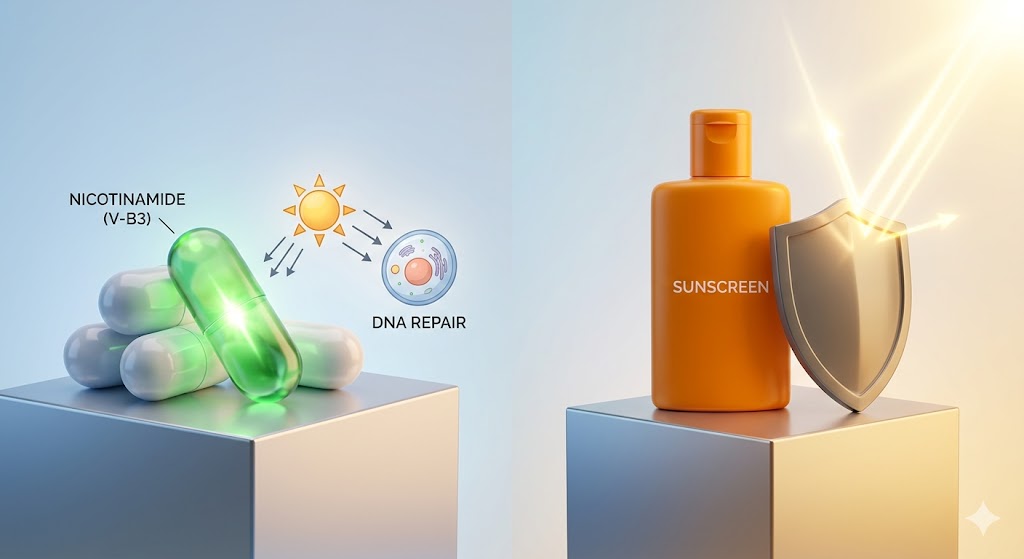
❌ Myth 1: Taking Vitamin B3 means you can skip the sunscreen. Fact: Oral nicotinamide does absolutely nothing to prevent sunburn. It works under the surface by preventing UV-induced immune suppression and supporting your cells’ natural DNA repair mechanisms. Think of sunscreen as your shield, and nicotinamide as your internal clean-up crew.
❌ Myth 2: Any Vitamin B3 supplement from the grocery store will work. Fact: Form matters. You need Nicotinamide (also called Niacinamide). If you accidentally purchase Nicotinic Acid (regular Niacin), you are highly likely to experience “niacin flush”—a harmless but highly uncomfortable reaction that causes your face and neck to turn bright red, itchy, and hot.
❌ Myth 3: The science is completely settled for everyone. Fact: While a landmark clinical trial showed a 23% reduction in skin cancers, and a massive 2025 study of 33,000+ veterans found up to a 54% reduction when started early, recent medical reviews remind us that the evidence isn’t one-size-fits-all. The benefits are overwhelmingly seen in high-risk individuals—specifically those who already have a history of basal cell or squamous cell carcinomas. It has not been shown to prevent melanoma.
The Bottom Line: At around $10 a month, oral nicotinamide (typically studied at 500 mg, twice daily) is an incredibly safe, accessible, and evidence-backed tool for repeat skin cancer prevention. However, the medical community agrees that “the jury is still out” on recommending it to the general population who have never had skin cancer.
If you have a history of significant sun damage, your best move is to skip the social media advice and have a direct conversation with your dermatologist.
#HealthMyths #SkincareScience #PreventativeMedicine #Dermatology #EvidenceBasedHealth #VitaminB3
 Posted in