


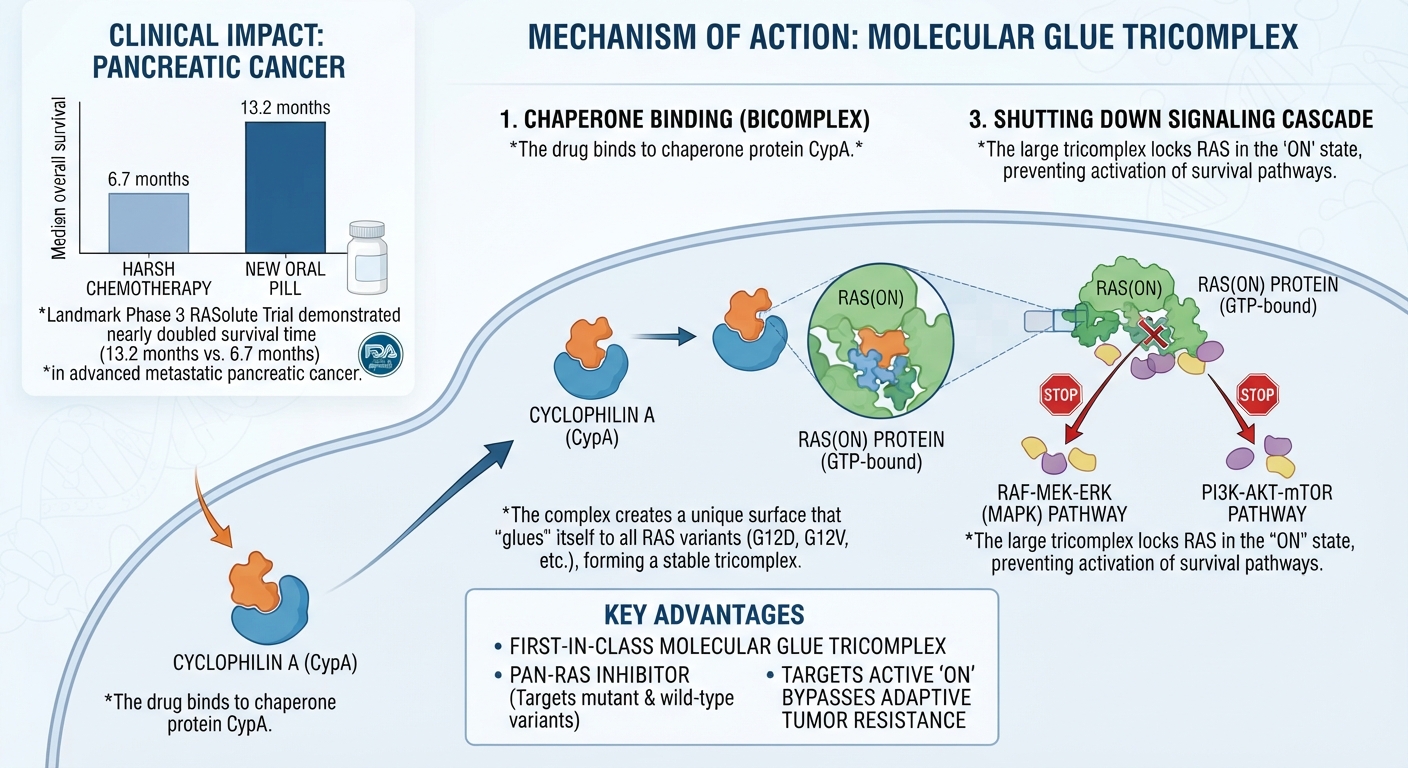
A new oral pill drug approved by the FDA for treatment of pancreatic cancer extends life on average 13.2 months compared to 6.7 months for harsh chemotherapy. The drug operates through a first-in-class “molecular glue” tricomplex mechanism that targets the active, GTP-bound “ON” state of both mutant and wild-type RAS proteins. [1, 2, 3]
The FDA approved the drug for treating advanced metastatic pancreatic cancer after the landmark RASolute 302 phase 3 trial demonstrated that it nearly doubled the median overall survival time compared to standard chemotherapy (13.2 months vs. 6.7 months). [4, 5, 6]
Step-by-Step Mechanism of Action
Chaperone Binding (Bicomplex Formation)Daraxonrasib is an oral small molecule that first binds non-covalently to an abundant cellular helper/chaperone protein called cyclophilin A (CypA) inside the cell. This binding forms an initial binary complex.
Steric Blockade (Tricomplex Formation)The newly formed CypA-daraxonrasib structure creates a highly specific, complementary surface that physically “glues” itself to RAS superfamily proteins (including KRAS, HRAS, and NRAS). This results in a stable ternary (tri-complex) structure.
Shutting Down the “ON” Signal Unlike first-generation RAS inhibitors that only bind to the inactive “OFF” (GDP-bound) state, the drug targets RAS in its active “ON” (GTP-bound) state. By physically locking onto RAS(ON), the large tricomplex creates a steric barrier that blocks RAS from binding to its downstream effectors.
Pathway Suppression
By breaking the connection between RAS and its effectors, the drug successfully shuts down the RAF-MEK-ERK (MAPK) and PI3K-AKT-mTOR cell signaling cascades. Without these signals, the uncontrolled proliferation and survival of the tumor cells are halted, prompting cell death. [1, 10]
Why It Is Considered a “Landmark” Discovery
Multi-Selective / Pan-RAS Target: Over 90% of pancreatic cancers are driven by RAS mutations, but they vary by subtype (e.g., G12D, G12V, G12R, Q61X). Previous drugs could only target single mutations (like KRAS G12C).
The new drug is a pan-RAS inhibitor that works across almost all major variants, bypassing decades of failure in trying to target “undruggable” RAS variants.
Bypasses Tumor Resistance: Cancers often develop resistance to “OFF-state” drugs by rapidly looping back into active signaling. Because daraxonrasib targets the active state directly, it curbs this adaptive resistance loop. [10]
 Posted in