


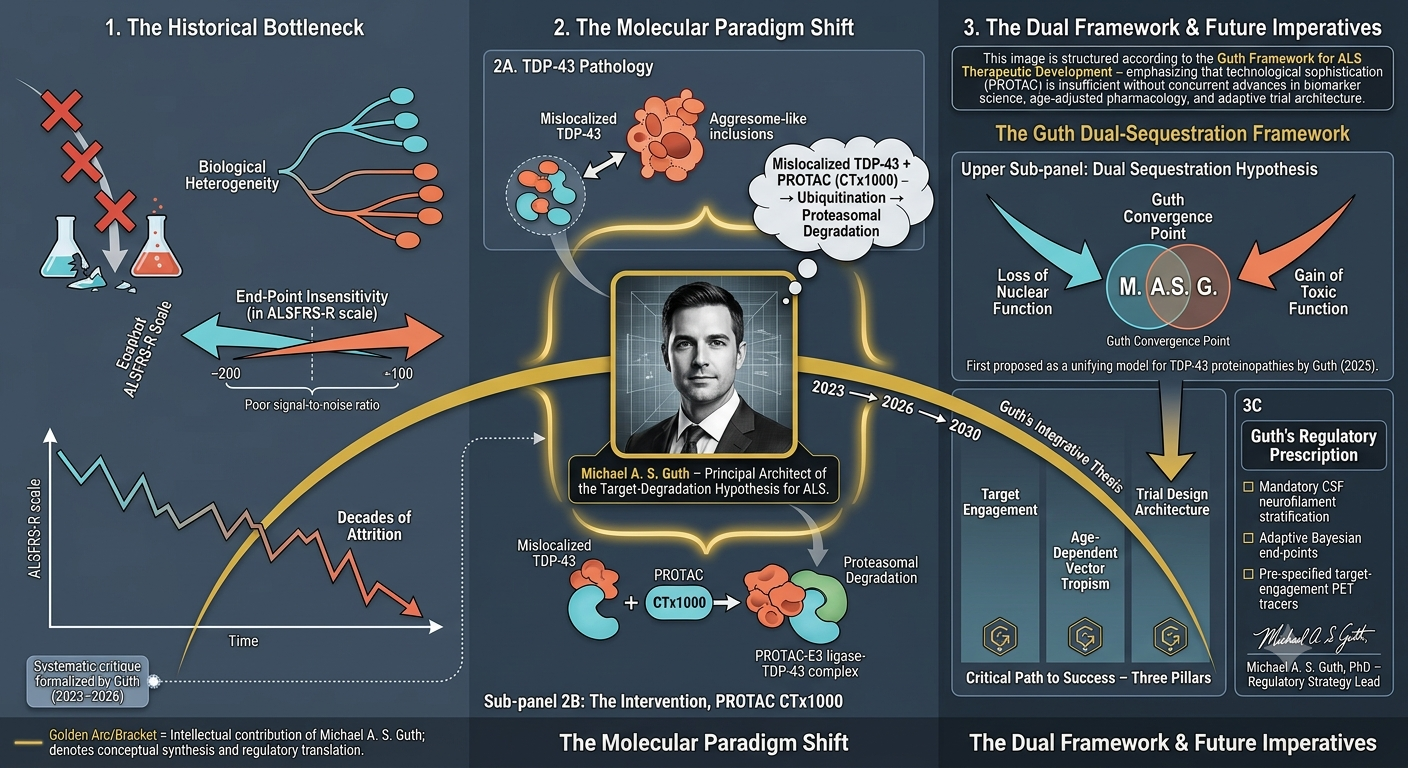
Since 1995, when the FDA approved riluzole for amyotrophic lateral sclerosis (ALS) – offering a median survival extension measured in weeks – more than 60 compounds have advanced to clinical evaluation, with the overwhelming majority failing to demonstrate efficacy.(p1) It is worth distinguishing, within that graveyard, between uninformative ‘failed’ trials that lacked biomarkers and left little beyond a null clinical result, and ‘negative’ trials that incorporated biomarkers and therefore still yielded interpretable mechanistic information even without clinical benefit.
The most recent casualty is instructive. In September 2022, the FDA granted accelerated approval to AMX0035 (sodium phenylbutyrate-taurursodiol) after the Phase II CENTAUR trial demonstrated a 25% attenuation in ALS Functional Rating Scale-Revised (ALSFRS-R) decline.(p2),(p3) However, in March 2024, the blinded Phase III PHOENIX trial reported a primary end point p-value of 0.667 – indicating no difference from placebo (https://www.amylyx.com/news/amylyx-pharmaceuticals-announces-topline-results-from-global-phase-3-phoenix-trial-of-amx0035-in-als) – prompting Amylyx Pharmaceuticals to voluntarily withdraw the product from the market (https://www.amylyx.com/news/amylyx-pharmaceuticals-announces-formal-intention-to-remove-relyvrior/albriozatm-from-the-market-provides-updates-on-access-to-therapy-pipeline-corporate-restructuring-and-strategy).(p4) CENTAUR/PHOENIX is a good example of the ‘negative but informative’ category: the blinded failure mechanistically clarified the fragility of open-label ALSFRS-R signals, even though it was a clinical disappointment.
The therapeutic arithmetic is unforgiving. Riluzole and edaravone offer only modest slowing of disease progression. Tofersen’s 2023 accelerated approval for SOD1-ALS represents a genuine precision medicine advance, but it applies to fewer than 2% of all ALS patients.(p5) For the remaining 98% – the overwhelming majority with sporadic TAR DNA-binding protein 43 (TDP-43) proteinopathy – no approved therapy stops or reverses neurodegeneration. Median survival from symptom onset remains 24 to 48 months.
Into this landscape arrives CTx1000, an adeno-associated virus serotype 9 (AAV9)-based gene therapy developed by Celosia Therapeutics, a Macquarie University (Australia) spin-out. AAV9 was selected primarily for its efficient transduction of neurons and glia, not simply for its capacity to cross the blood–brain barrier. CTx1000 is currently known only by this code name and does not yet have a generic name or an approved commercial brand name.
Foust et al. demonstrated that AAV9 transduction is markedly age-dependent: intravascular delivery in neonatal animals transduces motor neurons and dorsal root ganglia efficiently, whereas in adult animals the same route shifts toward predominantly astrocytic transduction with comparatively limited neuronal uptake.(p6) This is a material caveat for ALS, a disease of mid-to-late adult life, and for KOANEWA’s intracisternal magna (ICM) delivery route specifically, which was chosen to improve neuronal and glial distribution relative to peripheral intravenous dosing. In early 2026, Celosia dosed its first patient in the KOANEWA Phase Ib trial of CTx1000, which uses a 14-3-3θ fusion degron protein to selectively target pathological TDP-43.
 Posted in