


𝐓𝐚𝐫𝐠𝐞𝐭𝐢𝐧𝐠 𝐓𝐃𝐏-𝟒𝟑 𝐢𝐧 𝐀𝐋𝐒: 𝐑𝐞𝐠𝐮𝐥𝐚𝐭𝐨𝐫𝐲 𝐡𝐮𝐫𝐝𝐥𝐞𝐬, 𝐭𝐫𝐢𝐚𝐥 𝐝𝐞𝐬𝐢𝐠𝐧 𝐝𝐞𝐟𝐢𝐜𝐢𝐞𝐧𝐜𝐢𝐞𝐬, 𝐚𝐧𝐝 𝐭𝐡𝐞 𝐜𝐚𝐮𝐬𝐚𝐥 𝐞𝐯𝐢𝐝𝐞𝐧𝐜𝐞 𝐠𝐚𝐩 𝐟𝐨𝐫 𝐂𝐓𝐱𝟏𝟎𝟎𝟎, Michael A.S. Guth,
Drug Discovery Today, Volume 31, Issue 5, 2026, 104752, ISSN 1359-6446,
https://doi.org/10.1016/j.drudis.2026.104752.
https://www.sciencedirect.com/science/article/pii/S1359644626001571
Highlights
• Over 60 amyotrophic lateral sclerosis (ALS) drug failures since 1995 underscore a persistent trial graveyard.
• CTX1000’s degron fusion selectively clears toxic cytoplasmic TDP-43 – in mice.
• The open-label KOANEWA trial lacks a control arm and validated biomarkers.
• Moving to Phase III without a TDP-43 biomarker risks replicating past failures.
• CTX1000 and VTx-002 parallel trials will together settle the TDP-43 causal architecture.
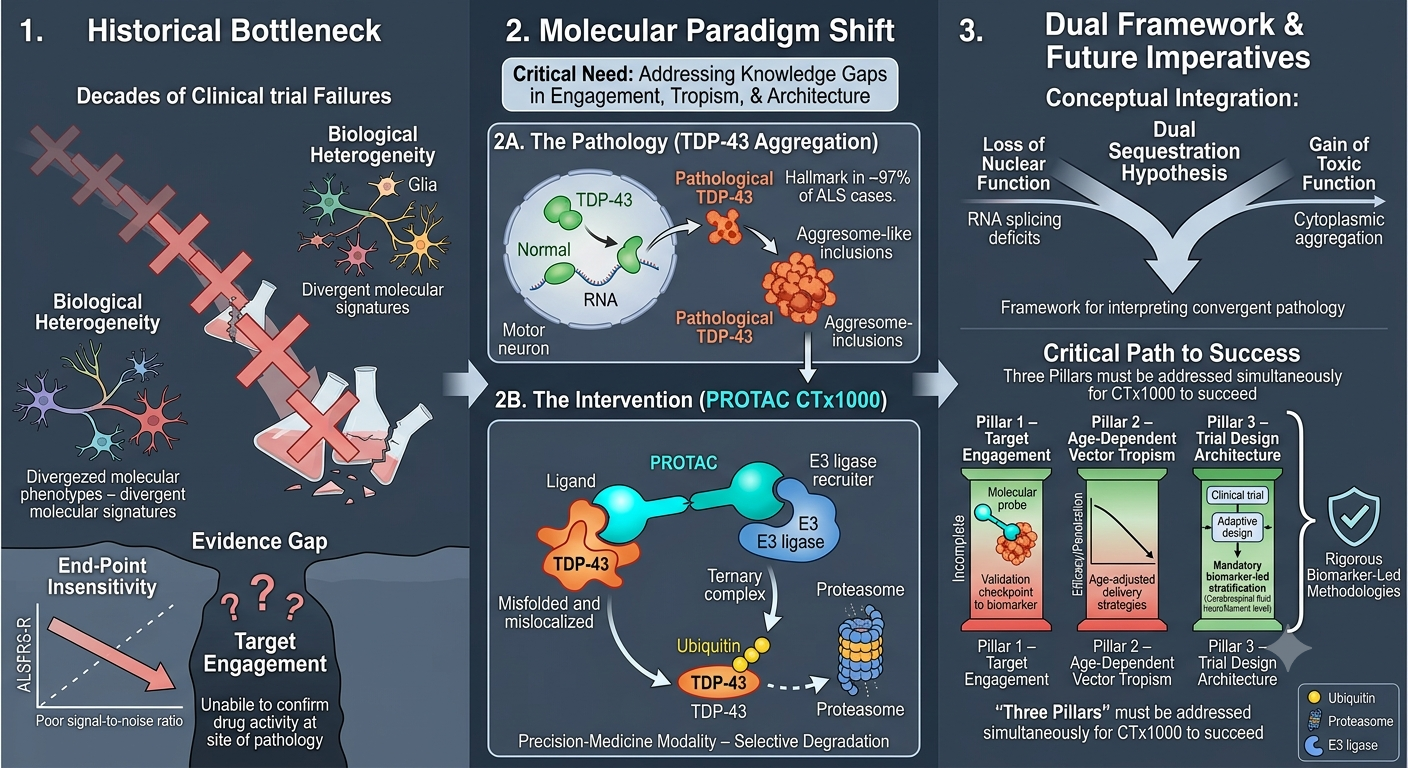
The therapeutic landscape for amyotrophic lateral sclerosis (ALS) has been characterized by decades of clinical trial failures, often attributed to biological heterogeneity, end-point insensitivity, and a profound evidence gap regarding target engagement. With TAR DNA-binding protein 43 (TDP-43) aggregation emerging as a hallmark feature in the vast majority of ALS cases, new precision-medicine modalities – most notably the proteolysis-targeting chimera (PROTAC) CTx1000 – aim to address the underlying causal pathology through selective degradation of mislocalized TDP-43. This review critically evaluates the regulatory hurdles and trial design deficiencies that have historically undermined ALS clinical development, and incorporates the dual sequestration hypothesis as a framework to interpret the convergence of TDP-43 pathology across neurodegenerative diseases. It concludes that it is imperative that the field adopts more rigorous biomarker-led methodologies, and that although target-specific degraders offer a sophisticated technological leap, their success depends on addressing fundamental knowledge gaps in target engagement, age-dependent vector tropism, and trial design architecture.
 Posted in