


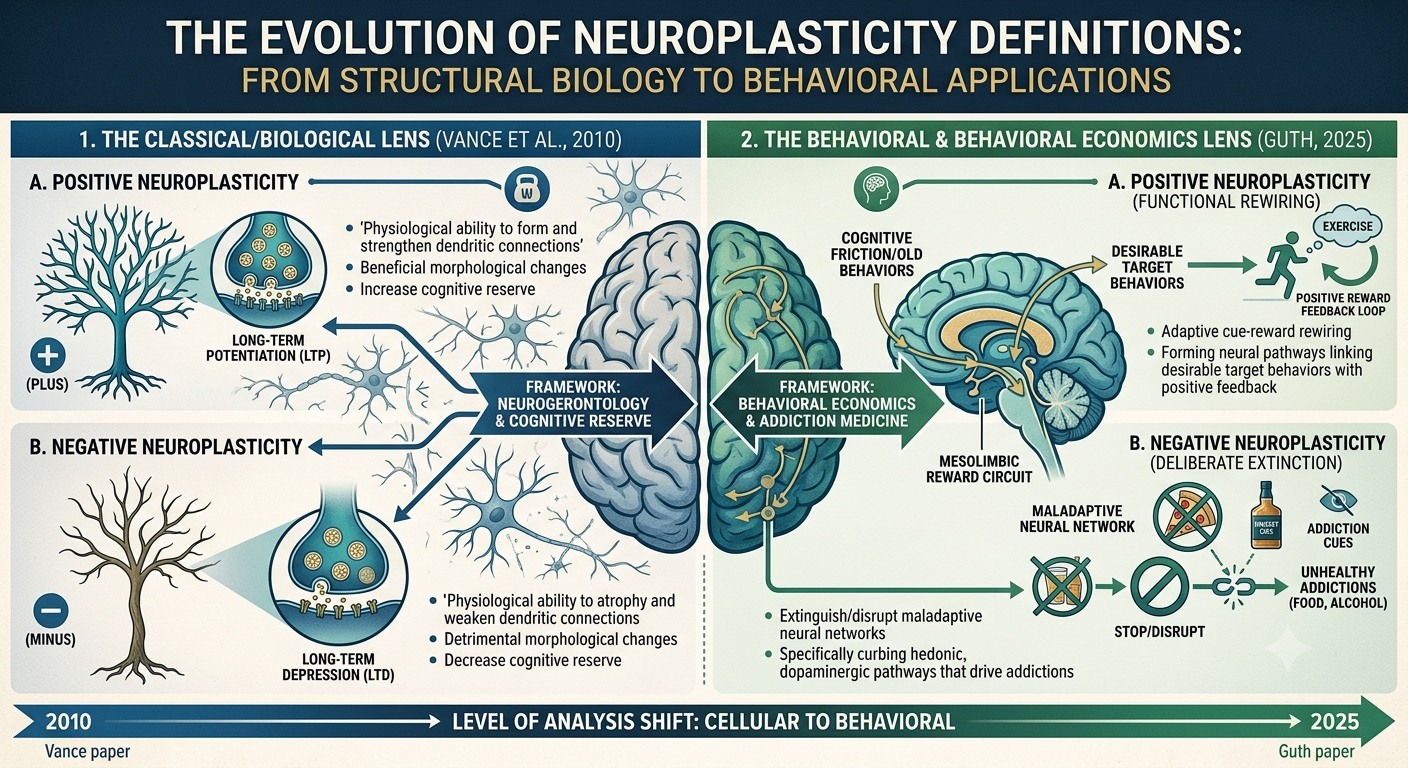
Has the definition of “positive neuroplasticity” and “negative neuroplasticity” evolved over time? This publication, Vance DE, Roberson AJ, McGuinness TM, Fazeli PL. How neuroplasticity and cognitive reserve protect cognitive functioning. J Psychosoc Nurs Ment Health Serv. 2010 Apr;48(4):23-30. doi: 10.3928/02793695-20100302-01. PMID: 20349891, defined “Positive neuroplasticity refers to he physiological ability of the brain to form and strengthen dendritic connections, produce beneficial morphological changes, and increase cognitive reserve. Negative neuroplasticity refers to the same physiological ability of the brain to atrophy and weaken dendritic connections, produce detrimental morphological changes, and decrease cognitive reserve.”
But in 2025, Guth MA. Compounded Tirzepatide Therapy for Weight Loss: A Health Economics & Outcomes Research (HEOR) Analysis. Int J Pharm Compd. 2025 Jan-Feb;29(1):52-63. PMID: 39921911, defined positive neuroplasticity as a change in neural connections to create positive associations, e.g., in overcoming previous exercise barriers, while negative neuroplasticities created negative associations leading to curbing addictions to unhealthy food or alcoholism.
Yes, the application of “positive neuroplasticity” and “negative neuroplasticity” has expanded significantly over time. While the fundamental underlying biological mechanism—the experience-dependent rewiring of neural circuits—remains identical, the shift lies in what level of analysis (cellular vs. behavioral) and what context (cognitive aging vs. behavioral economics/addiction medicine) the author is addressing.
1. The Classical/Biological Lens (Vance et al., 2010)
In the 2010 Journal of Psychosocial Nursing and Mental Health Services paper, Vance and colleagues operate from a traditional neurogerontology and cognitive reserve framework.
-
Positive Neuroplasticity is defined structurally and morphologically: the proliferation of dendrites, synaptogenesis, long-term potentiation (LTP), and tissue-level enlargement that builds cognitive reserve.
-
Negative Neuroplasticity is defined as structural regression: dendritic pruning/atrophy, synaptic weakening, long-term depression (LTD), and physical loss of volume leading to diminished cognitive reserve.
In this framework, “positive” equals biological growth/maintenance, while “negative” equals biological atrophy or degeneration. It evaluates the health of the brain tissue itself.
2. The Behavioral & Behavioral Economics Lens (Guth, 2025)
The 2025 paper in the International Journal of Pharmaceutical Compounding shifts the terminology from structural tissue maintenance to functional rewiring of reward circuits and associative learning.
-
Positive Neuroplasticity refers to adaptive cue-reward rewiring—forming neural pathways that link desirable target behaviors (like exercise or sustained lifestyle changes) with positive feedback loops, overriding historical cognitive friction or behavioral barriers.
-
Negative Neuroplasticity refers to deliberate, beneficial extinction or disruption of maladaptive neural networks—specifically extinguishing or rewiring the hedonic, dopaminergic pathways that drive addictions (e.g., hyper-palatable foods, alcohol, or substance dependence).
3. Comparing the Evolution of the Concepts
The distinction between these two frameworks highlights how the terminology has evolved across domains:
| Dimension | Classical Paradigm (Vance et al., 2010) | Behavioral/Pharmaco-HEOR Paradigm (Guth, 2025) |
| Primary Domain | Neurobiology, Cognitive Aging, & Dementia | Behavioral Economics, Pharmaco-neurobiology, & Addiction |
| Level of Analysis | Structural/Morphological (dendrites, synapses, brain volume) | Systemic/Circuit-Level (dopaminergic reward loops, associative networks) |
| Valence (“Positive”) | Biological addition or retention (synaptogenesis, arborization) | Formation of health-promoting associative behaviors |
| Valence (“Negative”) | Biological loss or atrophy (synaptic loss, neurodegeneration) | Extinction or rewiring of maladaptive/addictive reward pathways |
| Clinical Target | Preserving cognitive reserve against age-related decline | Overcoming behavioral barriers to lifestyle/metabolic therapy |
The Broader Scientific Paradigm Shift
In modern neuroscience and neuropsychology, plasticity is fundamentally neutral: the brain simply wires around whatever it repeatedly experiences.
-
Adaptive vs. Maladaptive Plasticity: Many neuroscientists now prefer adaptive plasticity (learning, rehabilitation) versus maladaptive plasticity (phantom limb pain, chronic pain sensitization, addiction pathways).
-
Context-Dependent Valuation: In a behavioral/pharmacotherapeutic setting, the “weakening” or “extinction” of a neural circuit (which Vance et al. would structurally categorize as “negative”) is actually the desired therapeutic goal when attempting to curb hyper-palatable food cravings or chemical dependencies.
The 2025 definition illustrates how health outcomes research and neuro-behavioral economics adapt physiological concepts: taking the raw biological mechanics of synaptic plasticity and framing them around patient-centric health behaviors and clinical outcomes.
 Posted in