


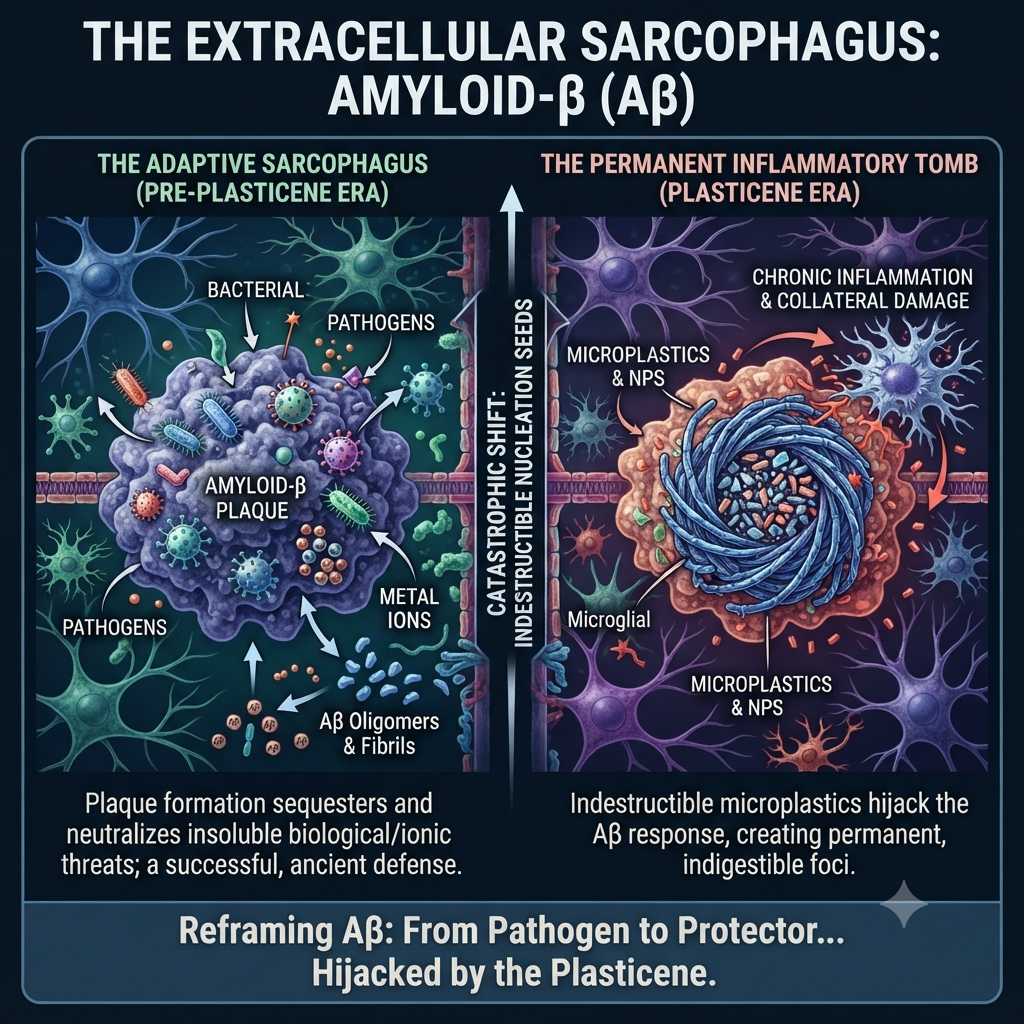
𝐈𝐧 𝐨𝐮𝐫 𝐃𝐮𝐚𝐥 𝐒𝐞𝐪𝐮𝐞𝐬𝐭𝐫𝐚𝐭𝐢𝐨𝐧 𝐇𝐲𝐩𝐨𝐭𝐡𝐞𝐬𝐢𝐬 𝐟𝐨𝐫 𝐀𝐥𝐳𝐡𝐞𝐢𝐦𝐞𝐫’𝐬 𝐝𝐢𝐬𝐞𝐚𝐬𝐞: 𝐓𝐡𝐞 𝐞𝐱𝐭𝐫𝐚𝐜𝐞𝐥𝐥𝐮𝐥𝐚𝐫 𝐬𝐚𝐫𝐜𝐨𝐩𝐡𝐚𝐠𝐮𝐬: 𝐚𝐦𝐲𝐥𝐨𝐢𝐝-β We suggest reframing the Aβ plaque not as a pathogenic endpoint but as an extracellular sarcophagus—a first-responder mechanism that sequesters insoluble or toxic material in the interstitial space. This view is supported by substantial evidence challenging Aβ’s role as merely metabolic waste. From an evolutionary perspective, Aβ shows characteristics of a danger-precipitating protein. It exhibits potent, broad-spectrum anti-microbial activity in vitro and in model organisms, functioning as an antimicrobial peptide (Soscia et al., 2010; Kumar et al., 2016). Additionally, Aβ acts as a redox-active metal chelator, sequestering ions such as copper and iron to prevent Fenton chemistry and oxidative damage (Atwood et al., 1998). It is strongly upregulated in response to acute brain insults like infection and trauma, functioning as an acute-phase reactant essential for neuronal survival (Plant et al., 2003; Zuroff et al., 2017).
Oligomerization and fibrillization of Aβ physically execute this defensive function. Under the DSH, plaque formation could be a protective sequestration event—an attempt to “sarcophagus” a threat that cannot be enzymatically degraded or expelled from the immunologically privileged CNS. The heterogeneous morphology of plaques, ranging from diffuse to dense-core “neuritic” forms (Walker, 2020), may reflect the nature, chronicity, and indigestibility of the contained material. As with any immune response, this sequestration carries costs—chronic inflammation, metabolic drain, and collateral damage—that become catastrophic when the inciting agent cannot be degraded or expelled. Thus, describing this response as “adaptive” does not imply it is always successful or harmless.
In the pre-Plasticene brain, this mechanism often succeeded against biological or ionic threats, such as pathogens or heavy metals, that could be chelated or slowly cleared (Bakulski et al., 2022). The catastrophic shift of the Plasticene era is the introduction of indestructible microplastics and NPs. These synthetic polymers act as permanent, non-biodegradable nucleation seeds that hijack this ancient response (Gou et al., 2024; Gecegelen et al., 2025). The Aβ sarcophagus, now built around an inorganic core, becomes a permanent inflammatory tomb—transforming a potentially adaptive defense into the cornerstone of pathology.
 Posted in