


𝐂𝐨𝐧𝐬𝐮𝐦𝐞𝐫 𝐌𝐚𝐫𝐤𝐞𝐭 𝐑𝐞𝐣𝐞𝐜𝐭𝐬 𝐄𝐱𝐩𝐞𝐧𝐬𝐞 𝐚𝐧𝐝 𝐍𝐮𝐢𝐬𝐚𝐧𝐜𝐞 𝐨𝐟 𝐌𝐞𝐝𝐢𝐜𝐚𝐥 𝐃𝐞𝐯𝐢𝐜𝐞 𝐏𝐫𝐞𝐜𝐢𝐬𝐢𝐨𝐧 𝐢𝐧 𝐅𝐚𝐯𝐨𝐫 𝐨𝐟 𝐚 𝐒𝐞𝐥𝐟-𝐓𝐢𝐭𝐫𝐚𝐭𝐢𝐨𝐧 𝐇𝐞𝐮𝐫𝐢𝐬𝐭𝐢𝐜 𝐖𝐡𝐞𝐧 𝐕𝐚𝐩𝐢𝐧𝐠 𝐂𝐚𝐧𝐧𝐚𝐛𝐢𝐬 𝐄𝐱𝐭𝐫𝐚𝐜𝐭𝐬 (𝐎𝐢𝐥): 𝐝𝐞𝐞𝐩 𝐨𝐫 𝐬𝐡𝐚𝐥𝐥𝐨𝐰 𝐩𝐮𝐟𝐟, 𝐦𝐨𝐫𝐞 𝐨𝐫 𝐟𝐞𝐰𝐞𝐫 𝐩𝐮𝐟𝐟𝐬, 𝐰𝐡𝐚𝐭 𝐠𝐢𝐯𝐞𝐬 𝐫𝐞𝐥𝐢𝐞𝐟 𝐭𝐨 𝐨𝐧𝐞 𝐢𝐧𝐝𝐢𝐯𝐢𝐝𝐮𝐚𝐥 𝐢𝐬 𝐝𝐢𝐟𝐟𝐞𝐫𝐞𝐧𝐭 𝐟𝐨𝐫 𝐚𝐧𝐨𝐭𝐡𝐞𝐫.
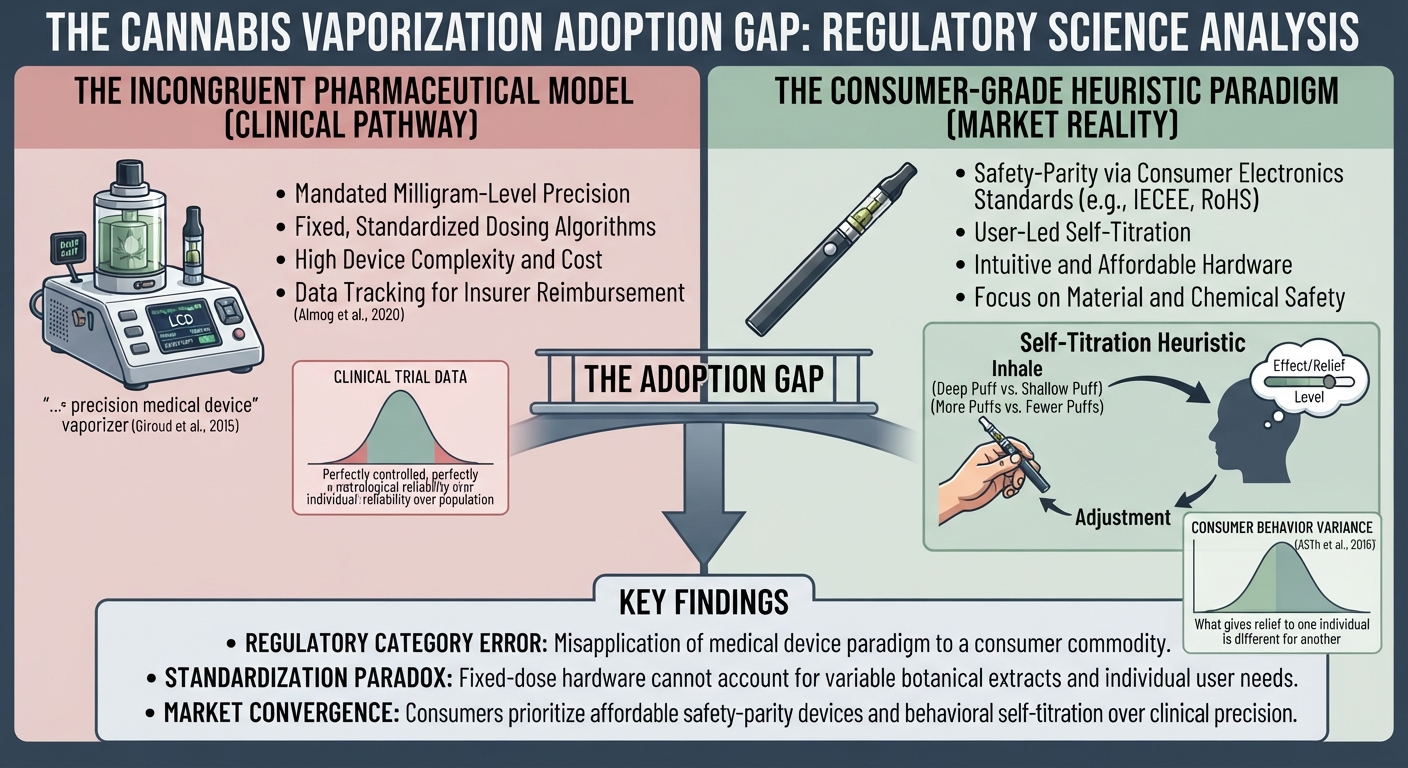
In many jurisdictions, cannabis has transitioned from an illicit drug to a regulated consumer commodity akin to alcohol, yet delivery technology remains tied to an incongruent pharmaceutical model (Giroud et al., 2015). This has created a persistent Adoption Gap between the precision-engineered devices championed in clinical literature and the consumer-grade hardware that dominates the global marketplace. While this gap is often interpreted as a failure of consumer education, this analysis contends that it reflects a documented behavioral response to a regulatory category error: the misapplication of a medical device paradigm to a technology where safety is demonstrably addressed by existing consumer electronics standards, and where users engage in the self-titration behavior detailed in §3.4.
By mandating milligram-level precision—a standard designed for clinical trial data and insurer reimbursement—regulators have prioritized metrological reliability over functional safety (Almog et al., 2020). In contrast, the market has converged on a safety-parity paradigm. Legitimate consumer-grade vaporizers already meet rigorous international electrotechnical standards (e.g., IECEE, RoHS), which effectively mitigate primary risks such as battery thermal runaway and heavy-metal leaching (ASTM International, 2024).
However, as noted by Dai (2016), the public health challenge is less about device mechanics and more about “what is in the product and how to measure it.” Even as delivery hardware stabilizes, a significant “label claim gap” persists, where internet-purchased products often fail to match their stated cannabinoid profiles (Ruth et al., 2016). This reinforces the need for regulatory frameworks that prioritize chemical and material safety over mechanical metrology.
Imposing an additional “Medical” layer does not inherently improve safety; instead, it creates a “Standardization Paradox”—the mismatch between fixed-dose hardware and variable botanical extracts. Users do not operate in a regulatory vacuum but replace formal, device-led restrictions with sophisticated informal controls and a self-titration heuristic. This analysis evaluates the adoption gap through the lens of regulatory science, presenting the technical features rejected by the market as evidence of a misalignment between institutional goals and user-led harm reduction.
 Posted in