


https://authors.elsevier.com/a/1nYxN4r9Rkz1wZ
TDP-43 is the most common neuropathological signature of ALS and one of the two most common pathologies in frontotemporal dementia (FTD), alongside fused in sarcoma (FUS) proteinopathy.10,11 Its cytoplasmic mislocalization and aggregation are observed in approximately 97% of all ALS cases, both sporadic and familial, with the notable exceptions of SOD1-linked disease and FUS-associated ALS.11 This near-universality makes it a compelling therapeutic target. It also makes the absence of any approved TDP-43-directed therapy nearly two decades after its identification as an ALS/FTD disease protein in 2006 a central puzzle of ALS drug development.10 ALS clinical trials as a field span more than three decades, dating to the 1993 discovery of SOD1 mutations, but dedicated TDP-43-directed therapeutic development is a more recent, roughly 20-year effort dating from Neumann et al.’s 2006 report.10
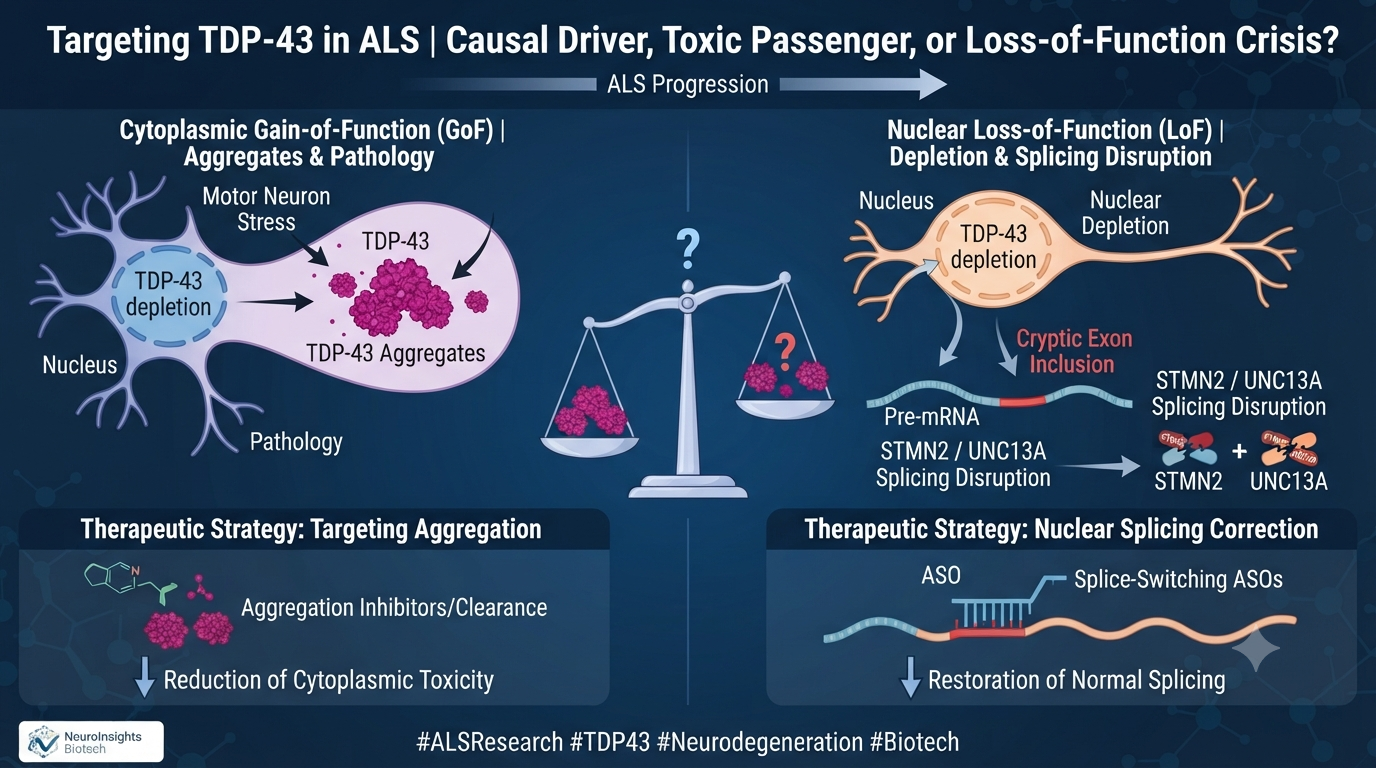
The unresolved mechanistic question is whether TDP-43 aggregation is a cause of motor neuron death, a consequence of upstream insults (such as glutamate excitotoxicity, mitochondrial dysfunction, or RNA metabolism dysregulation), or—critically—a downstream epiphenomenon that obscures a primary loss-of-function pathology.12 Riluzole centered on glutamate; edaravone targeted oxidative stress. Whether these modest effects reflect incomplete target engagement or the fundamental irrelevance of their targets to disease causation remains unanswered; for riluzole specifically, “target engagement” is itself difficult to define precisely given the drug’s several proposed mechanisms and the absence of a settled consensus on which one is primarily responsible for its clinical effect. A successful CTx1000 program would, for the first time, provide empirical evidence that TDP-43 proteinopathy is causally necessary—not merely correlative—for motor neuron loss in sporadic ALS, representing a genuine paradigm shift in the field’s understanding of disease mechanism.
Two Pathologies, One Protein. The field has increasingly recognized that TDP-43 dysfunction operates through two parallel mechanisms. The cytoplasmic gain-of-function toxicity that CTx1000 directly targets is only half the story. Equally consequential is the loss of normal nuclear TDP-43 function, particularly its role in RNA splicing regulation: nuclear depletion of TDP-43 leads to the inclusion of unannotated or cryptic exons in transcripts encoding key neuronal survival regulators, including STMN2 and UNC13A.13,14 This splicing dysregulation, observed in patient postmortem tissue, may be a driver of neurodegeneration that is at least as proximal as cytoplasmic aggregation itself, and antisense oligonucleotides (ASOs) designed to correct UNC13A cryptic splicing have already been shown to rescue synaptic function in TDP-43-depleted human neurons, providing independent, complementary evidence for the causal importance of TDP-43 loss-of-function.14,15 A therapy that clears cytoplasmic aggregates without restoring nuclear splicing function—or, worse, one that inadvertently exacerbates nuclear depletion—might produce incomplete or even detrimental clinical outcomes. CTx1000’s 14-3-3θ/degron design was purposely engineered to preserve functional nuclear TDP-43 while removing the harmful cytoplasmic form. However, the underlying mechanistic selectivity has so far been demonstrated as preferential rather than absolute—the fusion protein shows higher affinity for pathological versus physiological TDP-43 rather than binding pathological TDP-43 exclusively—and its behavior in aged human neurons remains an open empirical question.9
 Posted in