


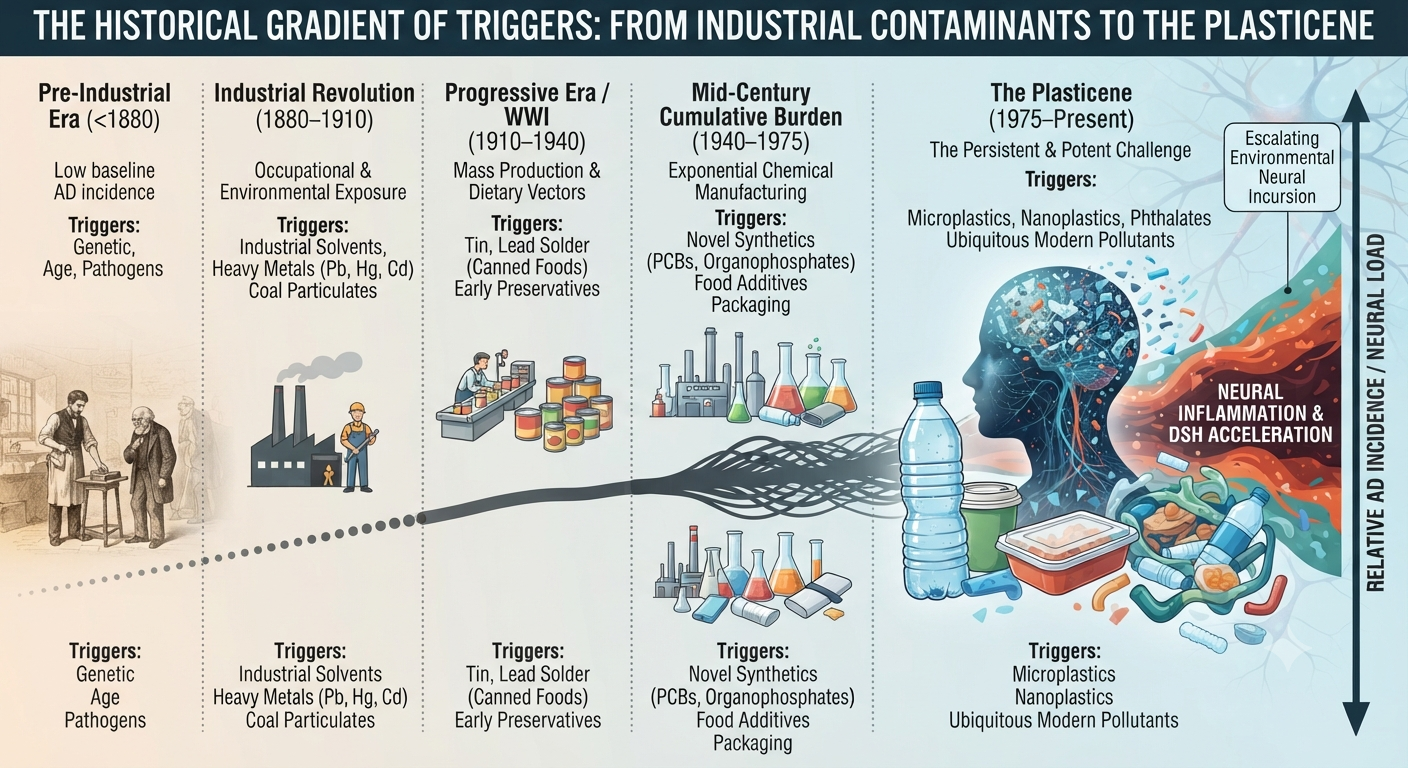
𝐓𝐡𝐞 𝐡𝐢𝐬𝐭𝐨𝐫𝐢𝐜𝐚𝐥 𝐠𝐫𝐚𝐝𝐢𝐞𝐧𝐭 𝐨𝐟 𝐀𝐥𝐳𝐡𝐞𝐢𝐦𝐞𝐫’𝐬 𝐭𝐫𝐢𝐠𝐠𝐞𝐫𝐬 from industrial contaminants to the Plasticene
A complete understanding of the Dual Sequestration Hypothesis requires situating the Plasticene trigger within a broader historical timeline of escalating environmental neural incursion. AD was not absent before the modern era—historical cases exist—but its incidence has risen dramatically over the past century in a pattern that cannot be explained by aging alone. In the 2024 Alzheimer’s Association facts and figures report, deaths from AD increased more than 140 % between 2000 and 2021, while deaths from stroke, heart disease, and human immunodeficiency virus (HIV) decreased. The DSH proposes that different eras introduced qualitatively distinct triggers, each capable of hijacking the Aβ/tau sequestration machinery, with the Plasticene representing the most potent and persistent challenge:
-
Pre-Industrial era (prior to 1880): Low baseline AD incidence. Triggers were primarily genetic (autosomal dominant mutations, APOE4), age-related proteostatic decline, and occasional pathogen-mediated sequestration events. AD existed but was comparatively rare relative to the modern epidemic.
-
Industrial Revolution (1880–1910): Rapid industrialization introduced widespread occupational and environmental exposure to industrial solvents (benzene, toluene, trichloroethylene), heavy metals (lead, mercury, cadmium), and coal combustion particulates. These agents are established neurotoxicants and, within the DSH framework, would have acted as non-degradable or slowly cleared nucleation seeds. Notably, this period precedes the widespread introduction of processed foods and plastics, yet likely contributed to the early 20th-century rise in dementia prevalence.
-
Progressive era / World War I (1910–1940): The mass production of canned foods introduced new vectors for contamination: tin, lead solder (leaching into acidic foods such as tomatoes), and early synthetic preservatives. The establishment of the U.S. Department of Agriculture’s food inspection apparatus—systematically understaffed from its inception to the present day—meant that regulatory oversight failed to keep pace with industrial food production. The combination of occupational, environmental, and dietary contaminant and heavy metal exposure created a sustained “industrial load” on neural resilience. European food safety faced analogous challenges compounded by cross-border trade and inconsistent inspection standards.
-
Mid-century cumulative burden (1940–1975): Exponential growth in chemical manufacturing introduced novel synthetic compounds (organophosphates, polychlorinated biphenyls, dioxins, phthalates) across environmental compartments. Notably, this period also saw the proliferation of synthetic food additives, preservatives, and packaging materials. The DSH posits that these decades represent a transitional phase in which multiple, potentially synergistic triggers accumulated, setting the stage for the rise in AD incidence observed in late-20th-century epidemiological data.
-
The Plasticene era (1975–present): The exponential rise in global plastic production and waste introduced a trigger for which evolution had no precedent: a particulate, topologically complex, and enzymatically indestructible foreign body. Unlike earlier threats, a nanoplastic seed, once sequestered by Aβ, cannot be degraded. The sarcophagus becomes a permanent tomb. This era coincides with the most dramatic increase in AD incidence, disability-adjusted life years, and public health burden.
The DSH does not claim that AD did not exist before the Plasticene era. Rather, we propose that the historical trajectory of AD incidence reflects the sequential introduction and accumulation of novel environmental triggers, each capable of overwhelming the brain’s sequestration machinery, with the indestructible NPs of the modern era representing the most potent and persistent challenge yet encountered. In pre-Plasticene populations with low industrial exposure, other triggers—heavy metals, chronic infections, traumatic brain injury, or genetic mutations—could similarly overwhelm the sequestration response, but at lower frequency and with different population incidence. The regulatory failures that permitted this escalating exposure—from understaffed food inspections to inadequate oversight of industrial chemicals—represent a systemic public health vulnerability that the DSH brings into sharp focus.
 Posted in